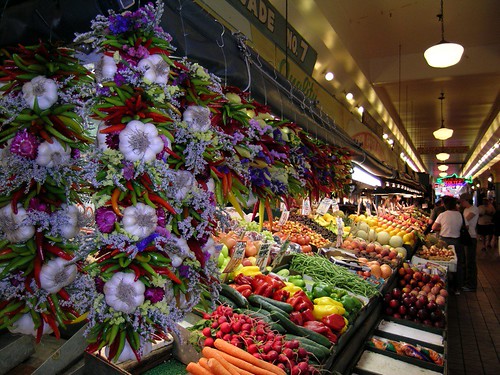
Have you ever stood inside of a crowded, busy town and just adored what an evolutionary market system and the simple laws of supply and demand, combined with human entrepreneurial spirits and abilities, can accomplish?
Just picture yourself on the same spot 30 years ago. Would you recognize your environment if you didn't know where you were beforehand? Probably not. So much has changed in so little time. Businesses that serve customers well have expanded or moved into larger buildings, thereby probably changing their appearance and resembling a newly risen star. Enterprises that didn't even satisfy niche demands anymore have quietly packed their bags and made room for more promising startups. Countless numbers of individuals move in different directions on the sidewalks, but still, their walk is smooth: they adapt their paths in their rational self-interest and benefit everyone else in the process.
Now go back 30 years again. Would you see many motorists? Depending on where you are, it may seem like a lot. But compare today: consider the sheer amount and luxury of the cars you see rolling in a straight line. Aerodynamic, dashing artworks that only seem to improve with every new model. And the variety: you'll see swift and compact mini-cars waiting next to a sturdy SUV before a red light. It seems like everyone is able to find a model that suits their needs nowadays.
Take a stroll down the retail strip. In Charles Dickens' "A Christmas Carol", we find a lovely description of the richness of goods that attempts to catch the attention of potential buyers in a busy city street in Christmas time:
Follow me to one last corner of the city. You see a gray, unattractive edifice which gives a saddening impression. In 30 years, next to nothing has changed on its exterior. It's a state building. It is not subject to the laws of supply and demand, and whatever is done in there seems to interest nobody except those who perform the actual work. Compared to the other parts of our town, this seems misplaced. It's like a sore thumb that is sticking out. You wonder, how is such a company going to survive? Then you remember, it's not a company. It's the state.
For one second, a thought crosses your mind that something might be inherently wrong with the nature of the state. But you reject it immediately. After all, somebody has to build the roads. Right?
Just picture yourself on the same spot 30 years ago. Would you recognize your environment if you didn't know where you were beforehand? Probably not. So much has changed in so little time. Businesses that serve customers well have expanded or moved into larger buildings, thereby probably changing their appearance and resembling a newly risen star. Enterprises that didn't even satisfy niche demands anymore have quietly packed their bags and made room for more promising startups. Countless numbers of individuals move in different directions on the sidewalks, but still, their walk is smooth: they adapt their paths in their rational self-interest and benefit everyone else in the process.
Now go back 30 years again. Would you see many motorists? Depending on where you are, it may seem like a lot. But compare today: consider the sheer amount and luxury of the cars you see rolling in a straight line. Aerodynamic, dashing artworks that only seem to improve with every new model. And the variety: you'll see swift and compact mini-cars waiting next to a sturdy SUV before a red light. It seems like everyone is able to find a model that suits their needs nowadays.
Take a stroll down the retail strip. In Charles Dickens' "A Christmas Carol", we find a lovely description of the richness of goods that attempts to catch the attention of potential buyers in a busy city street in Christmas time:
There were great, round, pot-bellied baskets of chestnuts, shaped like the waistcoats of jolly old gentlemen, lolling at the doors, and tumbling out into the street in their apoplectic opulence. There were ruddy, brown-faced, broad-girthed Spanish Friars, and winking from their shelves in wanton slyness at the girls as they went by, and glanced demurely at the hung-up mistletoe. There were pears and apples, clustered high in blooming pyramids; there were bunches of grapes, made, in the shopkeepers” benevolence to dangle from conspicuous hooks, that people’s mouths might water gratis as they passed; there were piles of filberts, mossy and brown, recalling, in their fragrance, ancient walks among the woods, and pleasant shufflings ankle deep through withered leaves; there were Norfolk Biffins, squab and swarthy, setting off the yellow of the oranges and lemons, and, in the great compactness of their juicy persons, urgently entreating and beseeching to be carried home in paper bags and eaten after dinner. The very gold and silver fish, set forth among these choice fruits in a bowl, though members of a dull and stagnant-blooded race, appeared to know that there was something going on; and, to a fish, went gasping round and round their little world in slow and passionless excitement. [...]That was miraculous in Dickens' times. Today, we're living in an even more elaborate Cockaigne: from every window, the finest clothes, the most delicious foods and the most sophisticated tools are literally begging to be bought. Your choices are overwhelming indeed.
Follow me to one last corner of the city. You see a gray, unattractive edifice which gives a saddening impression. In 30 years, next to nothing has changed on its exterior. It's a state building. It is not subject to the laws of supply and demand, and whatever is done in there seems to interest nobody except those who perform the actual work. Compared to the other parts of our town, this seems misplaced. It's like a sore thumb that is sticking out. You wonder, how is such a company going to survive? Then you remember, it's not a company. It's the state.
For one second, a thought crosses your mind that something might be inherently wrong with the nature of the state. But you reject it immediately. After all, somebody has to build the roads. Right?